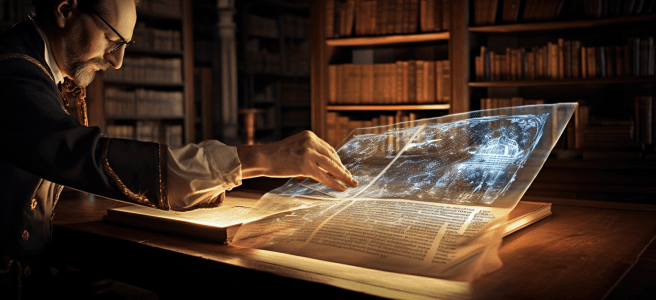
Imagine stepping into a vast, dimly lit library, where an old mage stands before an ancient tome, its pages glowing with arcane energy. With a wave of his hand, an identical book materialises in a distant tower, far across the land. No messengers, no parchment, no ink—just pure knowledge, transferred in an instant.
Now, replace magic with modern technology. Every time you send an email, download an e-book, or transfer money online, you’re doing something eerily similar: creating a new digital entity, a perfect copy of information appearing elsewhere in the world, with no physical movement involved. It feels almost magical—but it raises a fundamental legal question: who owns it?
The traditional legal approach to property
Since Roman times, our law has recognised that not all property is physical. Roman law recognised res incorporales—incorporeal things—as susceptible of private ownership. In the digital age, we deal with a new kind of res incorporales: res digitales—digital things. But how is ownership of res digitales determined?
A famous Roman legal principle states: If Titius has written a poem, a history, or a speech on your parchment, you, not Titius, are the owner of the written paper. In other words, if someone records information in a physical book, the book’s owner becomes the rightful owner of that recorded information. But does this logic hold up in the digital world? I suggest not.
Why the parchment analogy fails
One might argue that a digital device—such as a phone or computer—is a modern parchment, implying that its owner should also own all stored information. But this analogy breaks down because it doesn’t reflect how humans actually interact with digital information.
Consider the following: In our law, a parchment or a book is a single unit of property, not a collection of separate pages, molecules, or atoms. We don’t think of ink molecules as separate pieces of property—we own the book as a whole. Similarly, in the digital world, we don’t interact with binary code or silicon chips; we interact with digital objects themselves—emails, photos, documents, and videos. The device is merely a medium.
Consider a digital bank transfer. When you send money to someone, neither of you conceptualises the transaction as a rearrangement of binary code on a bank’s servers. You see it as money moving between accounts. This is how we experience res digitales: as distinct, functional entities, separate from the hardware that stores them.
Something out of nothing: the way of the digital world
If res digitales are separate from the devices storing them, then how is ownership established? Unlike physical things, res digitales come into existence out of nothing—res ex nihilo. If I create a new spreadsheet or a new email, it has no antecedent res. At the moment of creation, no existing mode of acquisition applies—making it res nullius. Think of taking a photo with your phone. In that moment, a new res digitalis—a digital photo file—comes into existence. Similarly, when a laboratory technician sequences someone’s DNA, a new genomic data file is created. This is not merely an arrangement of electrons; it is a new digital property, distinct from the physical storage medium.
Since res digitales starts as res nullius, the appropriate mode of acquiring ownership is appropriation—the legal principle that applies when someone takes control of unowned property with the intent to own it. For example, if you compose an email, the email file is created on your device. At that moment, it is res nullius. But as the person who controls it and intends to own it, you acquire ownership of that res digitalis. This principle extends to other digital objects, from videos to genomic data files.
Information generators stand to benefit
This has profound implications for information ownership. In the pre-digital world, recording information (like writing in a book) did not create new property—it simply added content to an existing res. But in the digital world, recording information digitally generates a new res. Therefore, ownership of digital information is not determined by who owns the physical device storing it, but by who controls the digital file and intends to own it. For example, if I create a new computer file that is simultaneously saved on a local hard drive and cloud servers, ownership is not determined by who owns the storage devices. Rather, as the creator, if I control the file and intend to own it, it belongs to me. This shifts the conversation away from outdated notions of physical ownership to a legal framework that mirrors how we actually interact with the digital world.
The digital age: a legal paradigm shift
In the pre-digital age, the idea that new property is created from nothing—like a mage conjuring books out of thin air—may seem counterintuitive. But this is the reality of our digital world. Every day, we create new res digitales, send them across the world, and interact with them as distinct pieces of property. Recognising this shift enables legal frameworks to evolve in line with human experience. In this brave new world of res digitales, ownership is no longer about who holds the parchment, but about who wields the magic.
I analyse this and more in my recent article in the South African Law Journal.


 Donrich Thaldar